Technical information
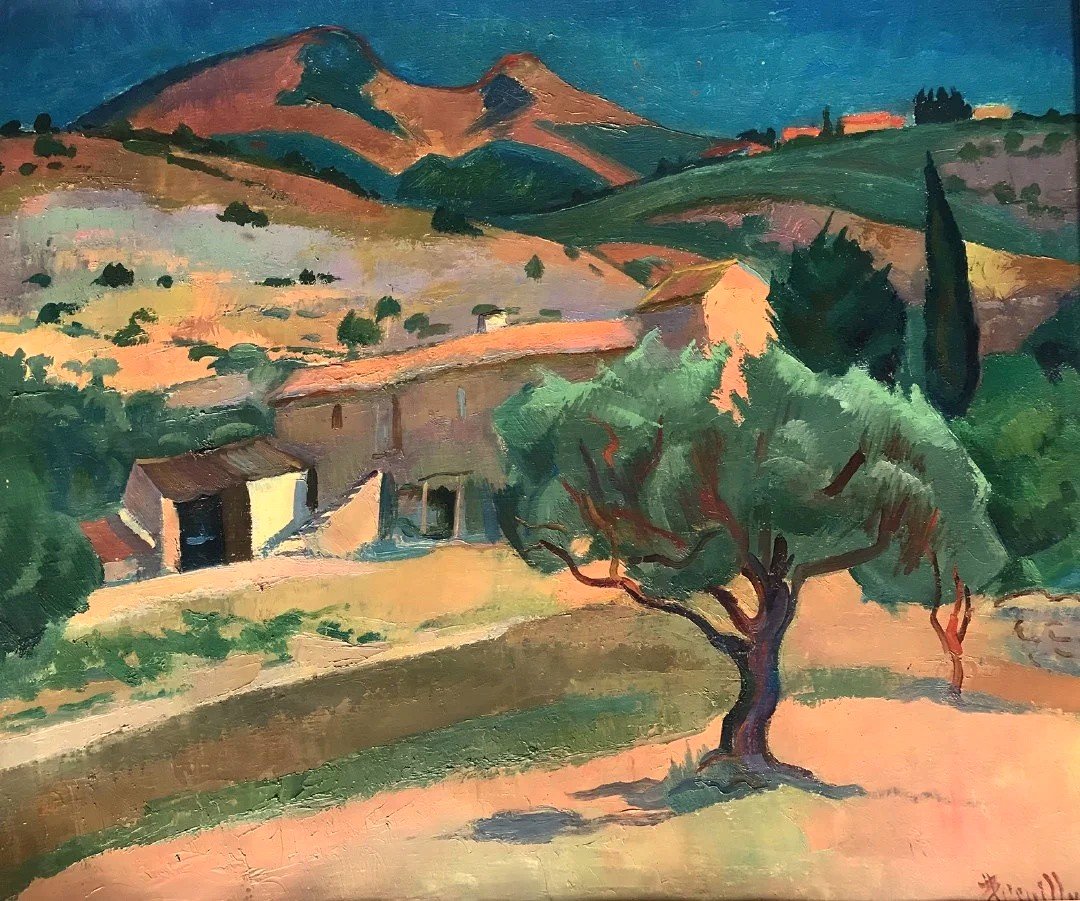
- Title : Rabeyrette Farm (II)
- Date : 1940
- Technique : Oil on canvas
- Dimensions : 46 × 55.5 cm
- Location : Private collection *
Biographical / historical context
The identification of Rabeyrette Farm provides a precise setting for this work, previously titled Paysage provençal (Provençal Landscape). It belongs to a group of three views of the same location, painted in 1940, in which the farm buildings, trees and twin summits of the Graveyron form a shared repertoire.
This second version brings the composition into closer focus around the relationship between the farm and a large olive tree. The landscape remains clearly identifiable, but its cohesion depends primarily on the interlocking of masses and the relationships between colours. The architectural and vegetal motifs share the surface without either being reduced to a merely supporting role.
Comparison with the two other paintings makes it possible to gauge this search for balance: the same site offers Breuillaud several possibilities of composition rather than the elements of an identical repetition.
Formal / stylistic description
The composition combines the farm, occupying the left half, with an olive tree rising just right of centre. The dark trunk, bending before branching out, is rooted in pale ground. Its branches lead to a broad crown rendered in green masses punctuated by brighter touches. The tree asserts itself through its silhouette while leaving a substantial part of the buildings visible.
The main body of the farm extends along a long, slightly oblique horizontal line. The warm-toned roof, ochre-grey façades and dark openings make it readily legible. A lower outbuilding to the left introduces a marked contrast between the brightness of its wall and the almost black rectangle of its entrance. To the right, a sunlit gable extends the architecture behind the foliage.
The foreground is distinguished by its openness. Broad areas of salmon pink, ochre and pale yellow receive the shadow of the olive tree, while a darker strip of ground runs obliquely across the lower left. This alternation of light and dark areas links the tree to the farm and directs the viewer’s gaze.
In the background, the hillsides are reduced to large expanses of colour, dotted with vegetation. The Graveyron stands out beneath a deep blue sky. Its pinkish slopes and blue-green shadows repeat, on another scale, the contrasts present in the nearer landscape. The slender silhouette of a cypress on the right introduces a narrow vertical counterpoint to the olive tree’s spreading crown.
Light is expressed chiefly through the relationships between surfaces: pale walls, orange roof, warm earth and cool foliage. Brushstrokes remain visible, particularly in the vegetation and the ground. Simplification does not efface the paint surface; it gives the handling direction and integrates it into the construction of volume.
Comparative analysis / related works
Compared with Rabeyrette Farm (I), AB-GU-1940-008, this version abandons the lateral distribution of several trees in favour of a dominant vegetal motif. The farm occupies more space, and its relationship with the olive tree becomes the principal compositional concern. The landscape thus acquires a more concentrated character without losing its opening towards the hills.
The closest comparison is with Rabeyrette Farm (III), AB-GU-1940-010. Both paintings associate a foreground tree with a group of buildings situated behind it, beneath the same twin summit. Yet they are not strictly superimposable variants: proportions, overlaps and the distribution of illuminated areas have been reworked.
In version II, the buildings remain largely legible, and the pale ground leaves generous breathing space around the trunk. The foliage establishes a visual continuity between the greens of the near and distant landscape. In version III, the tree forms a more substantial screen; blue-greens become more pronounced, and the light is concentrated more strongly on fragments of architecture.
Version II is thus distinguished by a particularly open balance between buildings, vegetation and areas of ground. Its brightness seems to be spread across several zones rather than reserved for a single focal point. The palpable presence of the place rests as much on this circulation of light as on the recognisability of its forms.
Justification of dating and attribution
The date of 1940 is retained in accordance with the catalogue information and the grouping of the three depictions of Rabeyrette Farm. Their topographical and formal kinship strengthens the appropriateness of presenting them together, without making it possible to determine the order in which they were painted.
The construction through broad fields of colour, simplification of the buildings, sinuous drawing of the olive tree and use of warm–cool contrasts provide the principal grounds for comparison. The signature visible at lower right complements these observations. No date is legible in the reproduction.
Differences in brightness and saturation between the photographs call for some caution in assessing precise colour nuances; differences in framing and the organisation of masses, on the other hand, remain clearly observable.
© Bruno Restout — Catalogue raisonné André Breuillaud