Technical information
- Title : The Harvesters
- Date : c. 1939
- Technique : Oil on panel
- Dimensions : 33 × 46 cm
- Location : Private collection
Biographical / historical context
Around 1939, André Breuillaud developed a rural vein in which agricultural labour became a subject of plastic condensation rather than a merely descriptive motif. Harvests, ploughing, teams of draught animals and peasant gestures offered him a repertoire of slow forms, rooted in the earth and in the horizon. In the climate of the late 1930s, these scenes take on a particular gravity: they oppose historical unrest with an image of continuity, seasonal rhythm and anchoring in the rural world.
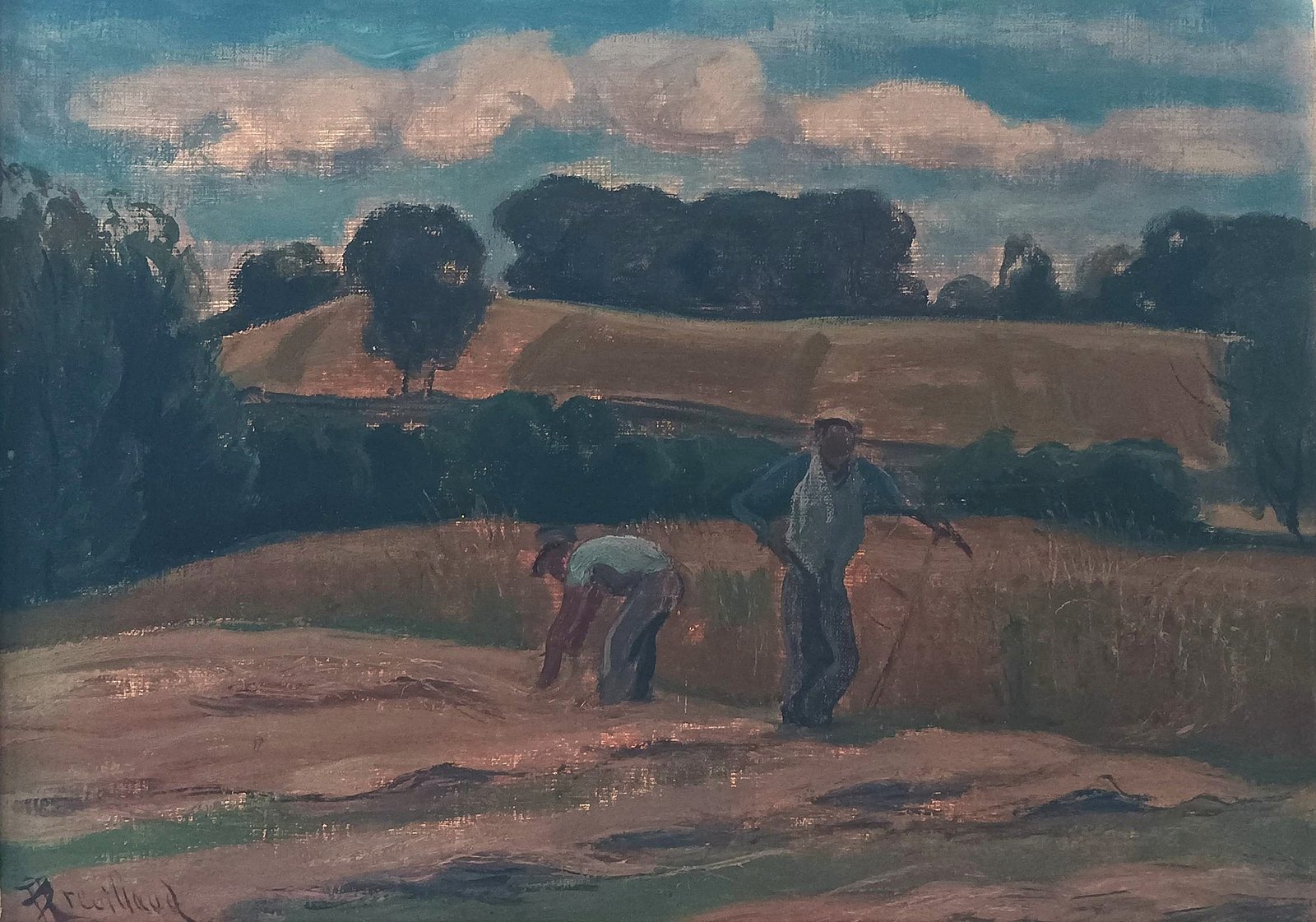
The Harvesters belongs to this group of works, but with remarkable economy. There is no team of animals, no cart, no emphatic narrative element: the scene is concentrated on two figures in the field, one bent towards the ground, the other standing, probably holding a tool. The old title on the reverse, recorded on the Galerie Berri-Raspail label, confirms the agricultural reading of the scene and constitutes an important documentary marker for the identification of the work.
Formal / stylistic description
The composition is organised in very legible horizontal registers. In the foreground, a broad pale area, pinkish and beige, is worked with large rubbed passages suggesting earth or a track. At the centre, the band of the field contains two silhouettes: on the left, a harvester bent over, almost absorbed into the gesture; on the right, a standing figure, more frontal, whose dark silhouette marks the space and gives scale to the landscape.
The background is built through an alternation of dark hedges, masses of trees and terraced fields. The blue-green sky, crossed by pinkish clouds, diffuses a low light, without direct brilliance. The palette is subdued: deep greens, purplish browns, pale ochres and greyed pinks dominate the whole. The painting does not seek a solar effect, but rather an atmosphere of late afternoon or overcast weather, in which work continues in restrained light.
The brushwork remains visible and relatively free. The figures are not individualised: faces and anatomical details disappear in favour of attitude and rhythm. Breuillaud is not painting an anecdotal harvest scene here; he transforms the peasant gesture into a sign, set within a broadly simplified landscape.
Comparative analysis / related works
The comparison with Oxen Ploughing in the Creuse (AB-GU-1940-004) is particularly illuminating. In that neighbouring work, Breuillaud likewise organises the scene in broad horizontal bands, around agricultural labour and a peasant presence. Ploughing, draught oxen and haystacks, however, give the subject a more developed narrative and monumental breadth.
By contrast, The Harvesters appears as a quieter and more pared-down version of the same rural world. Where the 1940 ploughing scene stages the collective effort of man, animal and plough, the present work reduces the narrative to two figures and a field. This reduction strengthens the atmospheric dimension of the landscape: the gestures are present, but as if suspended in a muted light.
This sobriety brings the work close to the research of the late 1930s, when Breuillaud was still seeking a balance between direct observation, plein-air painting and the simplification of masses. The Harvesters does not yet display the more assertive segmentation of the Provençal landscapes of the post-war period; it retains a supple handling, a blended palette and a more immediate relationship to reality, while already announcing a tendency towards synthesis.
Justification of dating and attribution
The dating to around 1939 is consistent with the rural theme, the subdued palette, the horizontal construction and the still-blended handling of the late 1930s. The subject of the harvesters belongs to the same atmosphere as the known agricultural scenes around 1939–1940, especially those connected with ploughing, teams of animals and field labour.
The attribution to André Breuillaud is supported by the visible signature at the lower left, by the old Galerie Berri-Raspail label mentioning the artist’s name and the title, and by the stylistic coherence with the known rural works of this period: organisation in bands, figures reduced to gestures, diffuse light and the progressive simplification of the landscape.
Provenance / exhibitions / publications
Private collection.
Old label on the reverse: Galerie Berri-Raspail, 29 boulevard Raspail, Paris (VIe), no. 1102, mentioning “Breuillaud”, title “Les moissonneurs”; additional handwritten indication partly legible.
© Bruno Restout - Catalogue raisonné André Breuillaud