Breuillaud & Mascart: the same landscape in Caromb
André Breuillaud and his friend Roland Mascart regularly stayed in Caromb and painted the same landscapes. This page places two very close works side by side.
Comparative analysis
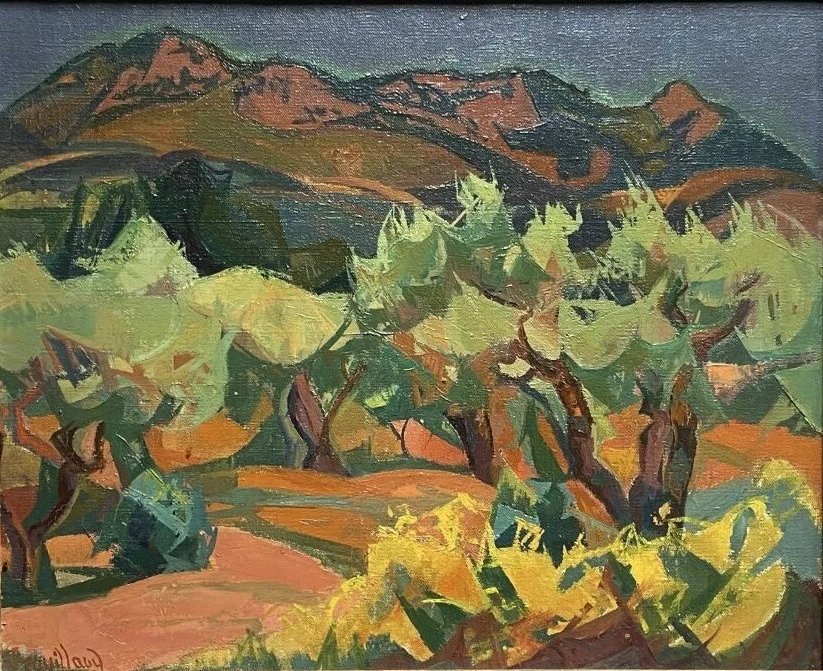
Made in Caromb more than twenty years apart, these two views of an olive grove help illuminate the singularity of Breuillaud’s gaze within a shared circle of friends and a common pictorial territory. In 1941, the artist develops, in a series of Provençal landscapes, a writing of forms in which the olive tree and the ridge line become true structuring motifs. The work privileges a construction in planes: an ochre, stony foreground; a frieze of olive trees in the middle; the mass of the relief in the background. Depth is organized less by linear perspective than by an assumed thermal contrast—warm oranges, muted yellows and earths against cooler greens and blues—and by a lively touch that sometimes lets the support show through, like a direct study seeking to fix the essential relations of shapes and colors.
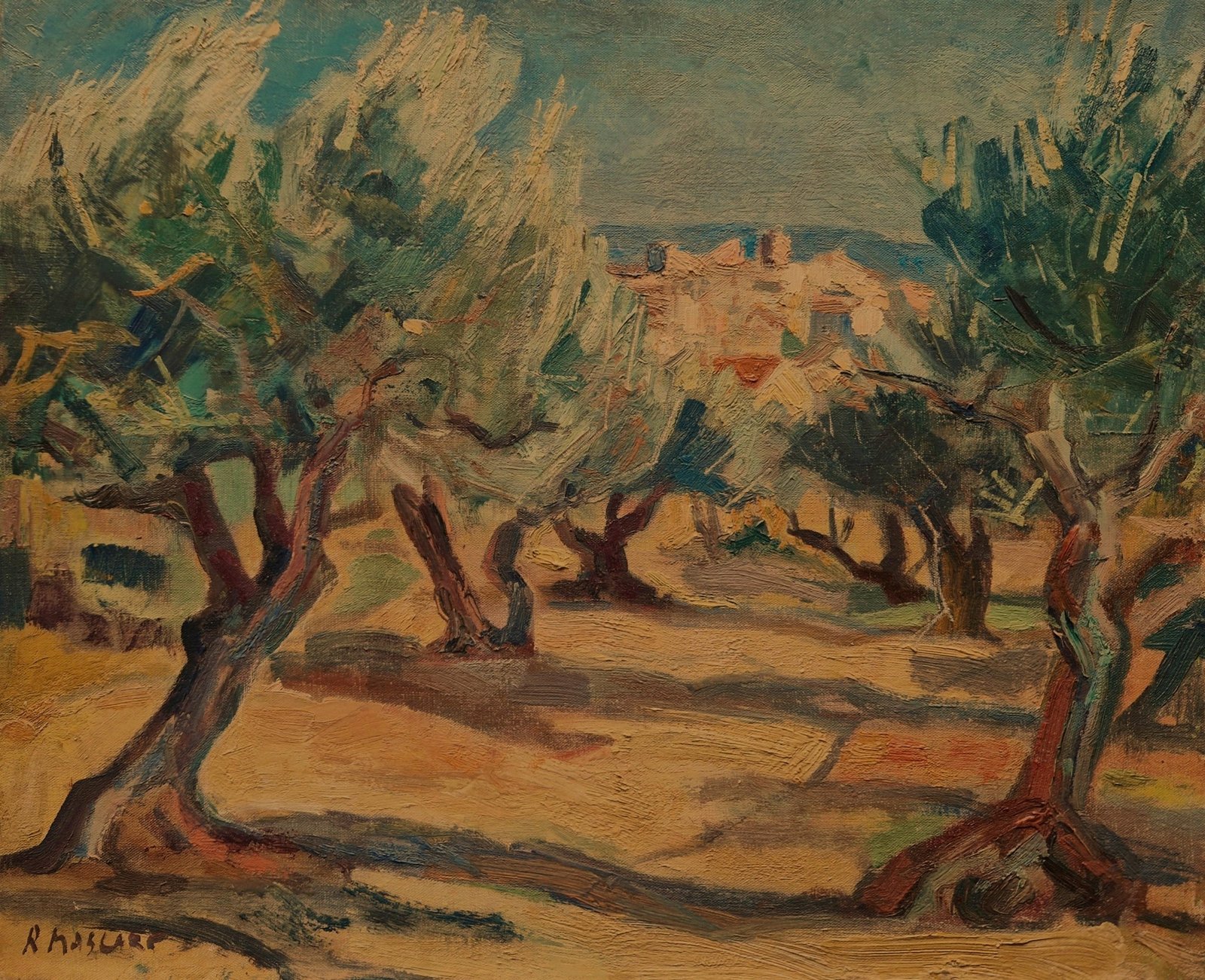
Roland Mascart’s canvas (1964) takes up the same Caromb theme—twisted olive trees, clearings, alternating shadow and light—but with a more stable palette and a broader brushstroke. The motifs are simplified: the olive grove becomes a network of silhouettes; the distant village is reduced to a light block. The painting’s rhythm is calmer; it emphasizes the spacing of trunks and the play of chromatic masses rather than Breuillaud’s tension of planes.
Seen together, the two images measure both proximity and distance. They share the same motif and the same horizon, yet they reveal two ways of organizing a landscape: in Breuillaud, a structural and energetic construction; in Mascart, an atmospheric balance. This comparison highlights Breuillaud’s early ability to make the Provençal motif a laboratory for form—a step toward the later metamorphoses of his work.