Studies and research · 1966
From drawing to canvas:
the secrets of Cosmique
The close relationship between the drawing and painting of Cosmic (I) reveals the precision underlying a teeming composition. A study of invention, colour and the genesis of the large works of 1966.
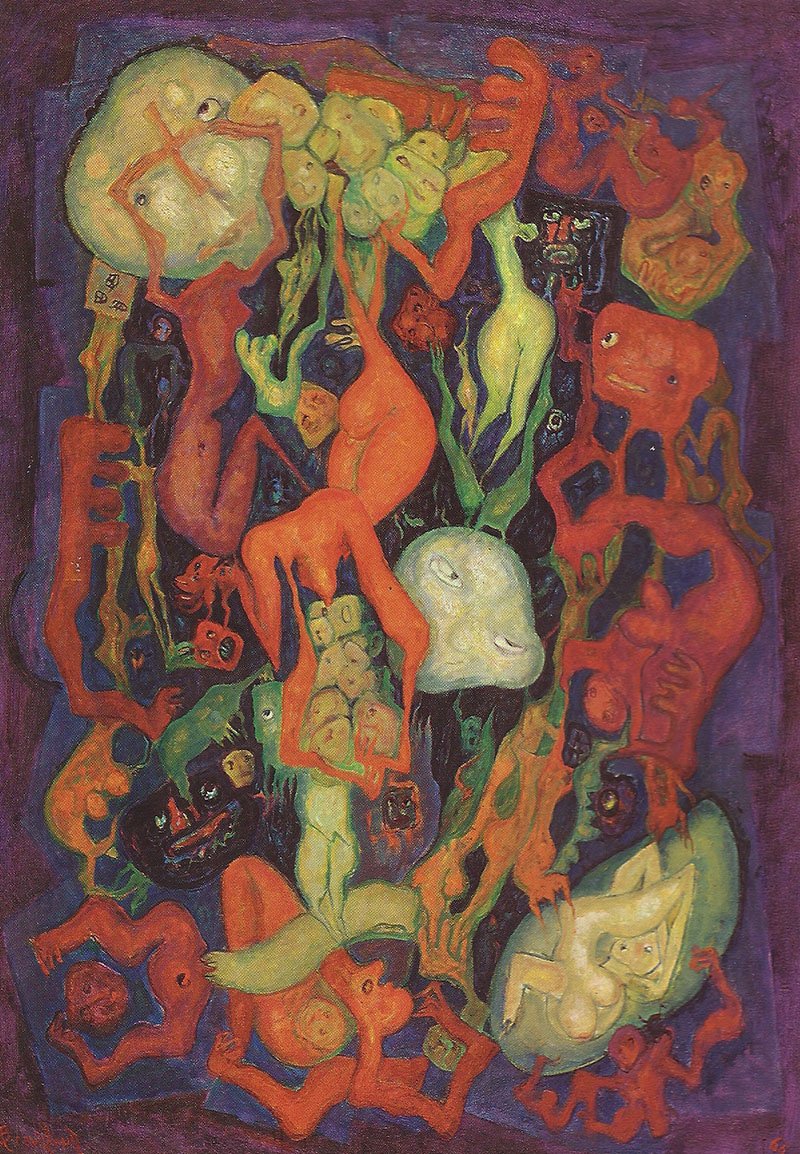
Pen and Indian ink on paper, 65 × 50 cm. Location unknown. Read the catalogue entryView full size (new tab)
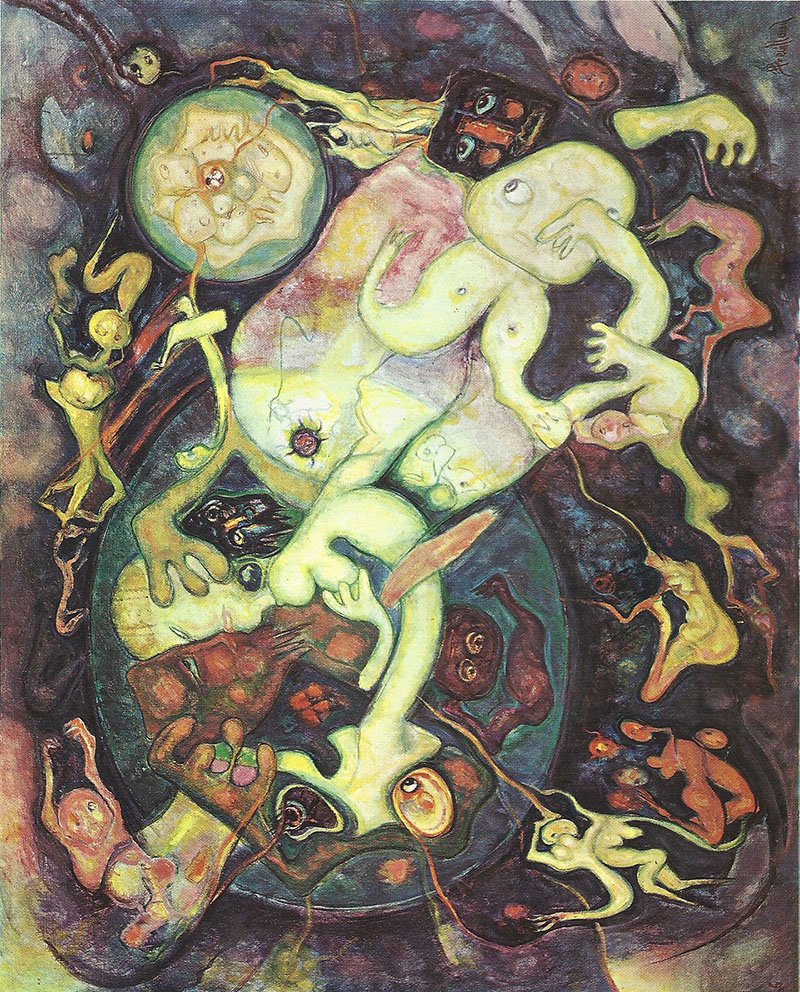
Oil on canvas, 162 × 114 cm. Private collection. Read the catalogue entryView full size (new tab)
The reproductions are brought together for comparison, not displayed at the same scale. Select an image to examine it at full size.
A profusion of forms, a precise construction
Among André Breuillaud’s large compositions dated 1966, Cosmic (I) presents a particularly dense world. In this oil on canvas measuring 162 × 114 cm, bodies, masks, faces and hybrid forms interlock to create an autonomous pictorial space. The eye moves from a large figure to a tiny silhouette, then discovers a face embedded within another form.
At first glance, this profusion may suggest an almost spontaneous invention. Comparison with the pen-and-Indian-ink drawing bearing the same title changes that impression. These are not simply two works sharing a visual vocabulary: they have the same overall organisation and numerous precise correspondences.
The large rounded group at the upper left, clusters of small heads in the upper register, elongated limbs traversing the field, the pale head in the lower register and the folded figure at the bottom right provide shared points of reference. Their relative positions make the compositional relationship especially compelling.
The comparison therefore documents the same formal organisation in two media. A preparatory function for the drawing is highly plausible; this should not, however, be confused with an established material chronology. Reproductions alone cannot determine the exact order of execution or reconstruct every stage of the work.
Drawing as the architecture of an imagined world
The 65 × 50 cm sheet entitled Cosmic (I) is far from a cursory sketch. Figures and signs occupy almost every part of its surface. Large silhouettes organise the vertical field; around them, profiles, fragmented bodies and small scenes multiply within the intervals.
Some figures are inverted, others doubled. Internal frames overlap, opening spaces within spaces. Yet this proliferation does not eliminate hierarchy: large masses can be read from a distance, while secondary motifs reveal themselves under close examination. An overall structure accommodates a multitude of possible visual paths.
The pen does more than trace outlines. Dense hatching, darker passages and areas of reserved paper separate or connect the figures. White is not an absence: it gives the forms their extent, their rhythm and, at times, room to breathe within the density.
In this sense, the drawing can be understood as the architecture of an imagined world. It makes meticulous organisation visible without reducing invention to a rigid programme. Even when considered preparatory, the sheet retains a power and coherence specific to its graphic language.
Imagination is not the opposite of construction. It becomes its driving force.
From ink to colour: a controlled transformation
The correspondences are numerous, but the canvas is not a mechanical reproduction of the drawing. A change of scale and medium alters perception. The figures remain recognisable; their relative intensity is redistributed.
Reds and oranges give the large forms a flesh-like, almost incandescent presence. Greens and yellows traverse the composition, while ivory tones isolate particular heads. Dark violets and blues create an environment that contains this profusion and strengthens its unity.
Where ink distinguishes figures through line, hatching and reserve, paint associates or contrasts them through colour. Some details readily identifiable in the drawing merge more closely into the painted surface. Others become focal points through their contrast with neighbouring forms.
The most revealing contrast is therefore not between a “finished” work and a secondary document, but between two ways of giving presence to the same organisation. The drawing exposes its articulations; the painting changes its tensions and its sensory impact.
Colour does not simply dress a previously conceived form: it transforms its relationships and possible meanings.
Why “Cosmic”?
The connection also concerns the title. The painting was previously studied in the catalogue raisonné under the assigned title Identity of the Realms. According to the catalogue documentation, the title Cosmique (I), or Cosmic (I), is documented through the drawing and now replaces that proposed designation. This correction requires a distinction between what can be observed in the image and what an earlier title encouraged us to read into it.
Hybridity and the transitions between forms remain visible. They no longer require the supposed identity of different realms of life to serve as the work’s single interpretative key. The word cosmic opens a broader reading: a world of intermingled scales, where each organism may contain or extend another, and no presence exists in complete isolation.
There is no need to regard this as an astronomical representation. The cosmos may instead be understood as a pictorial totality, a world composed of relationships and transformations. This remains a proposed interpretation, not an intention explicitly expressed by the painter in the available documents.
The viewer moves from a face to a body, from a scene to a fragment, before returning to something initially overlooked. The work does not offer a single narrative: it brings several centres of attention into coexistence within a shared space.
Cosmic (II): an open question
The second drawing, Cosmic (II), catalogued as AB-MP4-1966-010, offers a further point of comparison. Its horizontal composition presents a different arrangement of figures but comparable graphic precision: nested scenes, internal frames, large rounded motifs and repeated changes of scale.
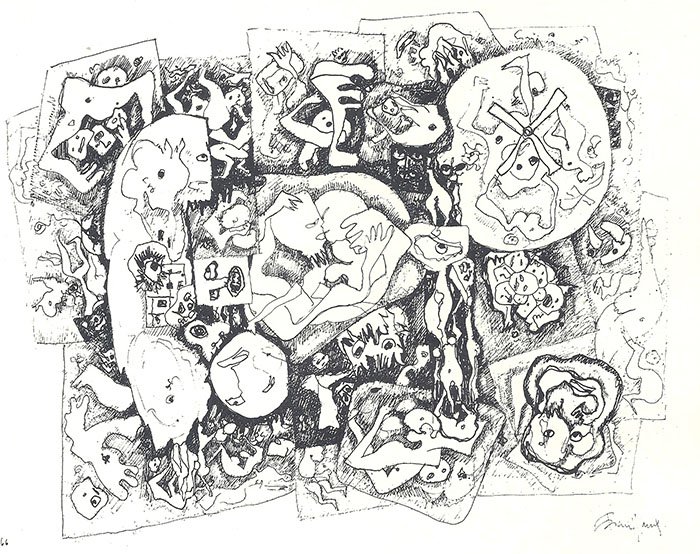
Pen and Indian ink on paper, 50 × 65 cm. Location unknown. Read the catalogue entryView full size (new tab)
Where Cosmic (I) develops a strong vertical thrust, this sheet works more through lateral expansion and juxtaposition. Together, the drawings show that the meticulous organisation of a teeming imagined world was not confined to a single composition.
According to the state of the corpus provided for this study, no painting corresponding precisely to Cosmic (II) has yet been identified. It would therefore be premature to assume that a canvas was necessarily executed and subsequently disappeared. The sheet may relate to a painting project, an independent graphic investigation, or a process whose continuation remains unknown.
A direction for studying the large compositions
The comparison between Cosmic (I) and its drawing offers an especially persuasive case for studying the genesis of Breuillaud’s works. It encourages the search for further correspondences in archives, catalogues and collections, attending not just to motifs but to their positions, relative scale and relationships.
It does not establish that every large canvas of 1966 or the following years was preceded by an equally detailed drawing. That possibility becomes a research hypothesis to be tested, rather than a general method already demonstrated.
The relative chronology of the two versions of Cosmic (I), any intermediate studies and the means by which the composition changed scale remain to be documented. The precision of the relationship does not, by itself, prove the use of tracing, squaring-up or any other transfer process.
Further comparisons may help clarify the respective roles of graphic planning and changes introduced during painting. The aim is not to reduce invention to a formula, but to observe how a vision takes form.
The rigour behind the freedom
This connection has a twofold significance: it restores a documented title to the canvas and reveals the coherence of a composition across two media. It invites us to move beyond a simple opposition between exuberant imagination and rigorous construction.
Beneath the apparent freedom of the metamorphoses, a sustained attention to formal relationships becomes visible. The drawing helps us read that structure; colour gives it a different intensity. It is in this relationship, as much as in either object considered separately, that a new key to the study of Cosmic (I) can now be found.
Documentation and sources
This study is based on the reproductions and catalogue raisonné entries supplied in October 2026. Compositional observations arise from their comparison; proposals about the meaning of the title and the creative process are presented as interpretations or hypotheses.
The three works
AB-MP4-1966-006 — Cosmic (I), drawing: 1966, pen and Indian ink on paper, 65 × 50 cm; location unknown.
AB-MP4-1966-007 — Cosmic (I), painting: 1966, oil on canvas, 162 × 114 cm; private collection.
AB-MP4-1966-010 — Cosmic (II): 1966, pen and Indian ink on paper, 50 × 65 cm; location unknown. No corresponding painting has been identified in the corpus supplied.
Bibliographic reference requiring verification
The entries report reproductions of these works in Georges Pillement’s 1967 book on André Breuillaud. Page or plate numbers remain to be checked in the original edition. This information is not presented here as a newly verified bibliographic finding.
State of research: October 2026. Dimensions, titles and dates follow the catalogue documentation. The former assigned title Identity of the Realms is retained in the research history, not as a title given by the artist.