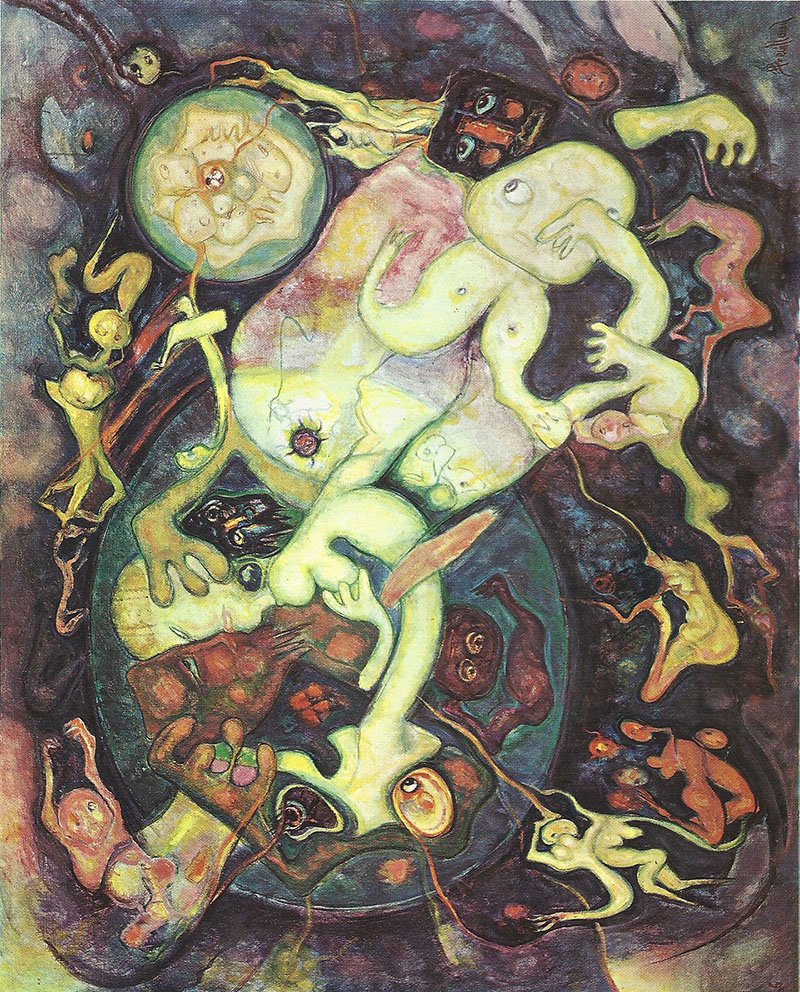
Technical information
- Title : Cosmic (I)
- Date : 1966
- Technique : Oil on canvas
- Dimensions : 162 × 114 cm
- Location : Private collection*
Biographical / historical context
In 1966, André Breuillaud gave monumental scale to a world of hybrid figures, multiplied faces and forms in flux. Cosmic (I), a canvas measuring 162 × 114 cm, belongs to this decisive moment when the artist made the painted surface the setting for the emergence of an autonomous world. The title now adopted, attested by the closely corresponding graphic work AB-MP4-1966-006, invites an interpretation in terms of a cosmos: not an astronomical representation, but an ensemble of forms, presences and transformations connected within a single space.
Bringing together the painting and the pen drawing profoundly changes our understanding of this work. At first glance, the extraordinary proliferation of motifs might suggest spontaneous emergence. Yet a precisely organised graphic composition corresponds to it, both in the arrangement of its principal figures and in a multitude of details. This document provides strong grounds for believing that the work was developed through a prior process of elaboration. The artist did not merely allow images to emerge through the handling of paint: through drawing, he also conceived the complex structure that he would develop on canvas. This discovery provides valuable material evidence of his working method at the turn of the 1960s and 1970s.
Formal / stylistic description
Set within a vertical format, the composition unfolds an entire population of metamorphic beings. Large red-orange bodies and fragments of bodies intertwine with heads of shifting appearance, masks, elongated limbs and clusters of small forms that may evoke, by turns, faces, budding growths or organs. Towards the upper left, a large pale figure folds in upon itself within an ovoid form; lower down, near the centre, flesh-toned figures coil around a network of green presences. An inclined ivory-coloured head, with serene features, provides a point of visual repose amid this profusion. Contours and gestures flow into one another without forming a single narrative scene.
Colour is the principal means by which the elements of this world are differentiated. Warm reds, oranges and ochres bring bodies to the fore; acid greens and yellows suggest other states of living matter, while slightly bluish whites set certain heads apart. Areas of dark violet and black form a deep framework that both encloses and connects the whole. Tonal contrasts, transitions in the handling of paint and the insistence of the outlines guide the eye from one focal point to another. Space does not open up behind the figures: it is constructed through their overlapping forms, their discordant scales and their proximity.
This density should not be mistaken for disorder. Despite the seemingly boundless range of motifs, the overall vertical emphasis, the distribution of warm and cool masses, and the repetition of rounded forms establish a coherent whole. The painting brings together almost human figures and signs that resist any stable identification; rather than narrating a particular metamorphosis, it organises the possibility of transformation across the entire canvas.
Comparative analysis / related works
The decisive comparison is with the drawing AB-MP4-1966-006, also entitled Cosmic (I), executed in pen and Indian ink on paper (65 × 50 cm). The two works share the same vertical organisation and numerous correspondences in the placement of their forms: a large folded shape in the upper left, a gathering of small heads in the central register, elongated or inverted bodies, a pale mask in the lower register and a tightly interlocking array of secondary figures. These are not simply motifs characteristic of the same period, but evidence of a genuine compositional relationship. The drawing thus appears to be a highly developed preparatory study for the canvas, while retaining its own value as a graphic work.
The translation into paint is nevertheless not a merely mechanical application of colour. Ink establishes boundaries, articulations and relationships of proximity; painting redistributes intensities, brings certain bodies into greater relief, darkens other passages and gives the forms a new chromatic presence. Where the sheet presents an interweaving of lines and unworked areas of paper, the canvas exploits colour temperatures and contrasts in the paint surface. The relationship between graphic plan and monumental realisation qualifies any view of the work as purely intuitive creation: formal freedom here rests on a carefully prepared construction.
The drawing Cosmic II (AB-MP4-1966-010) broadens the comparison. In a more horizontal arrangement, it presents another concentration of figures, internal frames and metamorphoses, developed with comparable precision. Since no corresponding painting has yet been identified, the sheet does not establish the existence of a second canvas. It does, however, show that working out compositions through drawing was an essential avenue of research in 1966. Connections with Le Jardin des masques (AB-MP4-1966-009) may be noted in the proliferation of figures, but they are of a different order from the direct compositional correspondence established with AB-MP4-1966-006.
Justification of dating and attribution
The date of 1966 is given in the catalogue documentation and accords with the MP4 phase, characterised by the expansion of organic forms and the development of large, densely populated compositions. The earlier catalogue entry mentions a reproduction of the canvas in Georges Pillement’s book published in 1967; this bibliographic reference still requires confirmation of the relevant page or plate. Above all, the correspondence with the drawing AB-MP4-1966-006, likewise assigned to 1966, strengthens the attribution and places both works within the same creative undertaking. The precise chronological precedence of the drawing, although highly plausible in view of its preparatory function, cannot be demonstrated from a comparison of reproductions alone.
Provenance / exhibitions / publications
Current location: private collection*. The work is reported to have been reproduced in Georges Pillement’s 1967 book on André Breuillaud (page or plate number to be completed after verification). The painting is directly related to the drawing AB-MP4-1966-006, Cosmic (I).
© Bruno Restout - Catalogue raisonné André Breuillaud