Technical information
- Title : Cosmic (I)
- Date : 1966
- Technique : Pen and Indian ink on paper
- Dimensions : 65x50
- Location : Unknown
Biographical / historical context
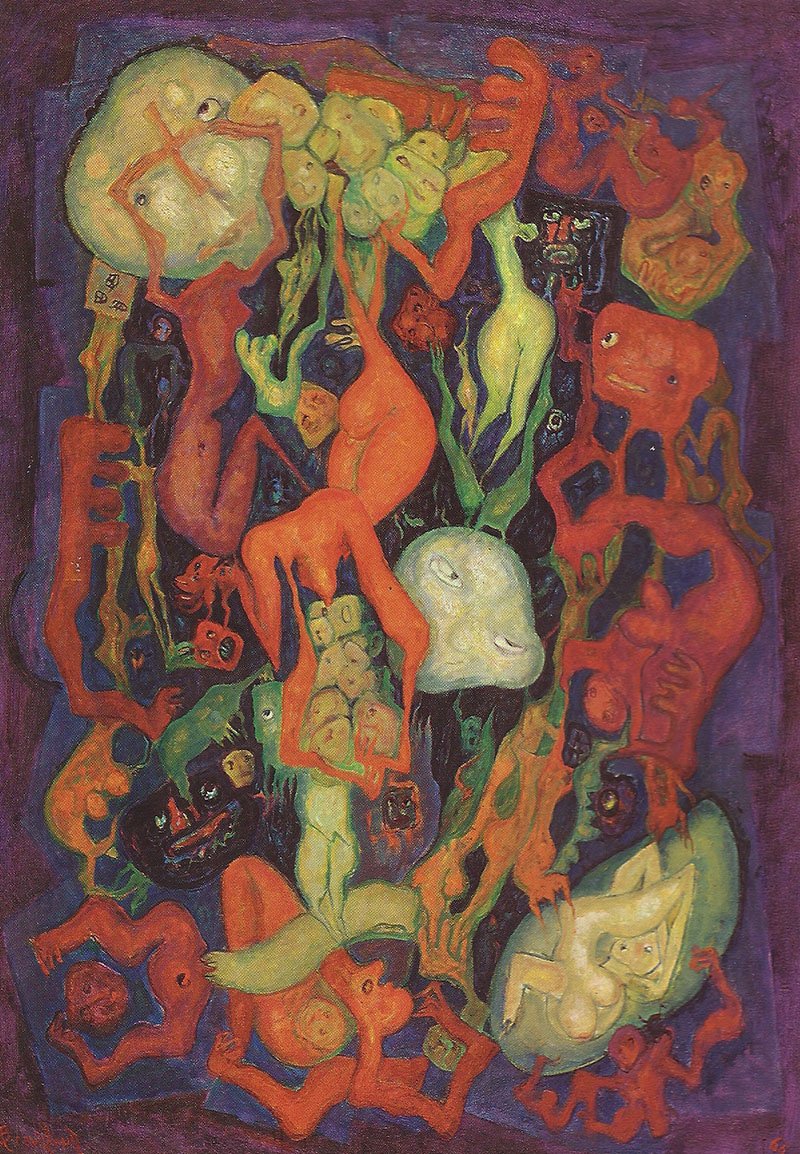
Cosmic (I) now occupies an essential documentary place in the study of André Breuillaud’s work in 1966. Once potentially regarded as an autonomous graphic composition within the MP4 cycle, the drawing can be compared point by point with the large oil on canvas AB-MP4-1966-007 (162 × 114 cm), which bears the same title. This correspondence is not limited to the subject or the vocabulary of forms: it extends to the overall structure of the composition and the arrangement of numerous figures. The sheet thus assumes the significance of an exceptionally detailed preparatory study for a monumental work.
This observation illuminates a major aspect of the painter’s approach. The multitude of beings, masks, bodies and signs that appear to emerge freely on the surface of his large canvases also results from a process of graphic planning. The pen allows him to determine the rhythm of masses, interlock silhouettes, leave passages open and organise complex visual movement before its possible translation into colour. Yet the graphic work is complete in its own medium: its preparatory status diminishes neither its precision nor its inventive force.
Formal / stylistic description
On a vertical sheet, Breuillaud uses the pen to develop a dense network of interlocking figures. A large rounded volume, inhabited by faces or fragments of heads, occupies the upper left. Towards the top and along the central axis, small masks multiply in clusters within and around larger forms. Supple figures, with raised arms or bent limbs, traverse the composition; further down, a large, inclined, pale head opens up an area of stillness amid the bodies, hands and interlocking forms. Everywhere, secondary profiles and small scenes are inserted between the principal motifs, right up to the edges of the image.
Black ink does more than define outlines. Through hatching, reserved areas of white paper and varying densities, it creates depth, isolating some figures while others seem to emerge from a continuous ground. The drawing articulates several scales of viewing: an overall architecture perceptible from a distance, and a profusion of details revealed by close examination. Despite the multiplication of presences, a vertical thrust unites the different registers. Repeated curves, correspondences between large heads and small masks, and the movement of sinuous gestures give the drawing its organic unity.
Comparative analysis / related works
Comparison with AB-MP4-1966-007, the oil on canvas entitled Cosmic (I), establishes the documentary significance of the sheet. The principal formal landmarks recur in both works: the ovoid form in the upper left, clusters of figures in the central register, elongated limbs, inverted heads and a pale mask in the lower register. The observable differences in treatment or in certain details arise from the passage from one medium to another, rather than from two unrelated inventions. The precision of these correspondences justifies identifying the sheet as a compositional plan for the painting, even though no archive survives that would establish the exact sequence of stages.
The comparison also shows what the transition to oil paint adds to the project. On paper, hierarchy is established by contrasts between black and white, the density of the hatching and the energy of line; on canvas, flesh-like reds and oranges, acid greens, ivory pallors and violet grounds redistribute the accents. Some figures acquire greater autonomy through colour, while others merge into the overall fabric. The drawing therefore provides a precise architecture, but the painting remains a formal reinterpretation rather than the simple colouring-in of this framework.
The other known sheet entitled Cosmic II (AB-MP4-1966-010) extends this line of inquiry. Its more horizontal arrangement, multiplied small scenes and nested frames reveal the same concern for meticulous pen composition, but offer a different spatial solution. In the absence of an identified corresponding painting, it should be regarded as a graphic parallel, not as evidence of a second monumental work. Together, these drawings make visible a method of exploration worth examining in later works, without extending it to the entire corpus in the absence of further documented correspondences.
Justification of dating and attribution
The date 1966 appears in the documentary file and accords with the characteristics of MP4 compositions from that year. The earlier entry indicates that the drawing was reproduced in Georges Pillement’s monograph published in 1967, a bibliographic point requiring verification against the original edition. The exceptionally close relationship with the canvas AB-MP4-1966-007 provides an unusually strong additional argument for the attribution, closely linking two media within the same compositional project. Although its preparatory function appears very firmly established, the documentation does not at present reveal the precise chronology of successive studies.
Provenance / exhibitions / publications
Current location: unknown. The drawing is reported to have been reproduced in Georges Pillement’s 1967 book on André Breuillaud, in the section devoted to drawings (page or plate to be verified). It is directly related to the canvas AB-MP4-1966-007, Cosmic (I).
© Bruno Restout - Catalogue raisonné André Breuillaud